

BSc Nursing vs GNM: Which One Should You Choose?
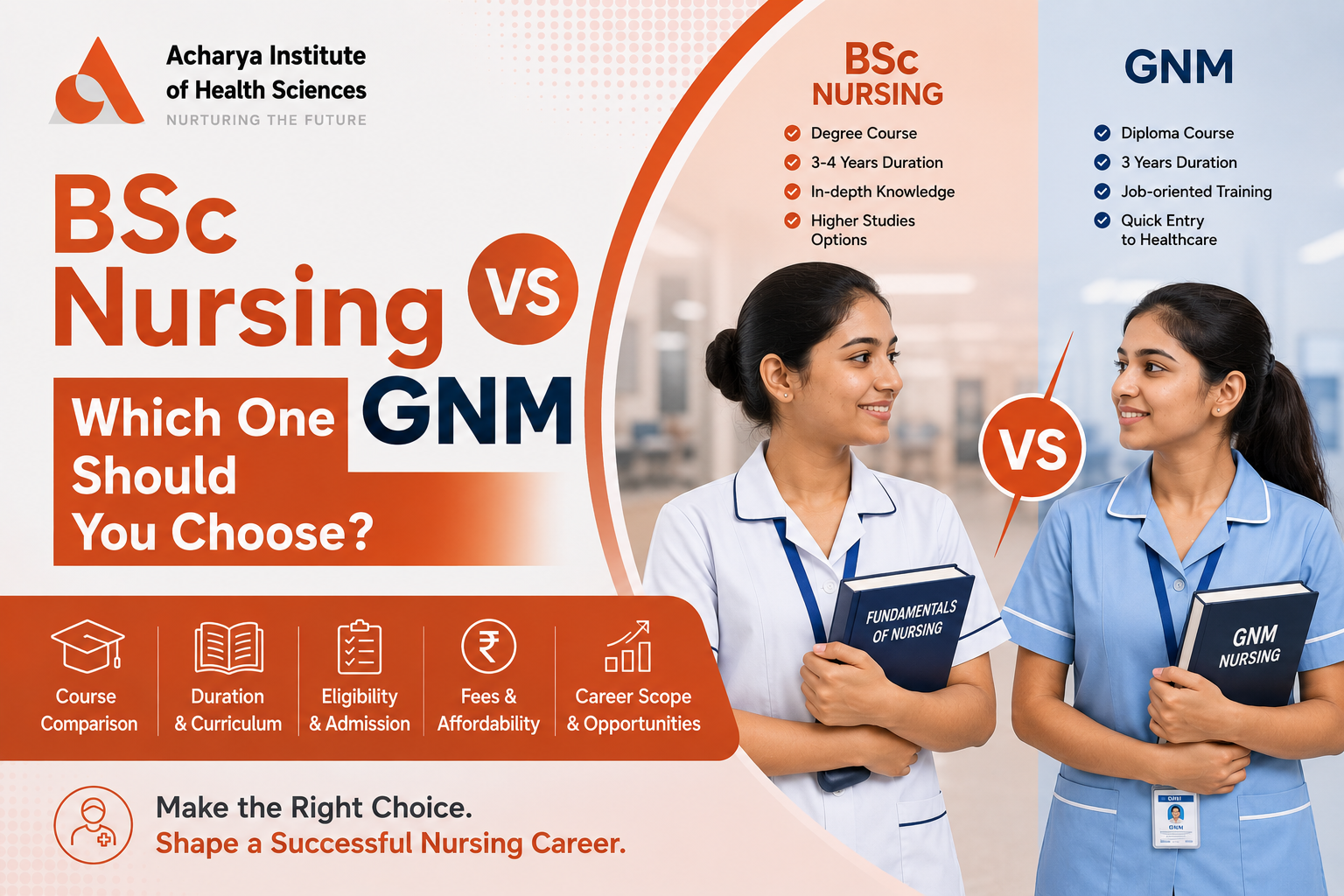
Nursing is one of the few careers where demand almost never dries up, which makes the entry route the decision that actually matters. **BSc Nursing vs GNM** is the first fork in the road for most Class 12 students eyeing nursing, and it's a fork that shapes not just your first job but your first decade in the profession.
Neither path is a shortcut, and neither is a mistake; they're built for different starting points, one trading speed for depth, the other trading depth for speed. This guide lays out the duration, the difficulty, the salary reality and the career ceiling for both, so you can choose the pace that suits you instead of the one that sounds more impressive at a family dinner.
BSc Nursing vs GNM: The Core Difference in What Each Path Actually Is
BSc Nursing is a four-year undergraduate degree that combines nursing science with broader academic education. GNM, General Nursing and Midwifery, is a three-year diploma built around hands-on clinical training. That's the core split.
Neither path is superior on paper. They're built for different starting points. **Is GNM and BSc Nursing same?** No. One is a degree with a longer academic runway. The other is a diploma that gets you into clinical practice faster.
| Factor | BSc Nursing | GNM |
|---|---|---|
| Qualification type | Undergraduate degree | Diploma |
| Duration | 4 years | 3 years + internship |
| Approach | Academic + clinical, broader base | Clinical-first, hands-on early |
| Core skill built | Clinical practice plus research and management grounding | Direct patient care skills, fast |
| Registration outcome | Registered Nurse (degree holder) | Registered Nurse (diploma holder) |
| Further study | Direct route into MSc Nursing | Bridge programme needed for MSc Nursing |
Course Structure Compared: Degree Depth vs Diploma Speed
BSc Nursing spreads nursing sciences across four years, alongside general academic subjects like English, sociology and psychology, with specialty clinical postings arriving later in the programme. GNM compresses clinical training into three years, with practical postings starting earlier and far less general coursework layered in.
The difference between GNM and BSc Nursing really comes down to depth versus speed. BSc Nursing takes longer but builds a wider academic base. GNM gets you into the ward sooner, with a tighter, practice-heavy curriculum.
We won't repeat the full subject list here. Our detailed guide to BSc Nursing subjects and syllabus covers that semester by semester.
BSc Nursing or GNM - Which Is Easier? An Honest Answer
Neither one is objectively easier, and anyone who tells you otherwise is oversimplifying. **BSc Nursing or GNM which is better** really depends on how you handle the specific pressure each one applies.
GNM is intensive in a shorter window. Clinical postings start early and stack up fast, so the workload hits hard from year one. BSc Nursing spreads the load across four years, but it adds academic and research-methodology components that GNM simply doesn't cover, which some students find just as demanding in a different way.
Here's a quick self-test. Do you want clinical exposure as fast as possible, even if it's intense early on? Or would you rather spread the intensity over more years in exchange for a broader academic and research grounding? Your answer points you toward the right pace, not the "easier" option, because there isn't one.
Which Path Suits Which Student? A Self-Check Before You Apply
Read both profiles and see which sounds closer to you.
You're likely a better fit for GNM if:
- You want the fastest route into clinical, hands-on work
- You learn best by doing rather than through classroom theory
- You're open to bridging into a full degree later, once you've got real ward experience
- You want to start earning sooner rather than later
You're likely a better fit for BSc Nursing if:
- You want the complete degree upfront, in one continuous run
- You're comfortable with four years of combined academic and clinical study
- You're already thinking ahead to MSc Nursing, teaching or hospital administration
- You want stronger footing for government exams and international placements
Career Paths After BSc Nursing vs GNM: Registration, Roles and Growth Ceiling
Both paths start you in direct patient care. Where they diverge is the ceiling.
GNM graduates typically start as staff nurses, in home healthcare, or in community health roles, entry-level clinical positions across hospitals and clinics. BSc Nursing graduates start in similar staff nurse roles, but carry degree-level standing that opens ICU and critical care postings sooner, along with a stronger footing for government recruitment exams and international nursing placements.
**BSc Nursing vs GNM** in career terms comes down to this: GNM gets you working faster, BSc Nursing gives you more room to climb without needing to bridge into a further qualification first. Both are respected, registered nursing roles. The ceiling is what separates them.
BSc Nursing vs GNM Salary: What Nurses Actually Earn in India
Numbers help more than vague claims, so here they are. Per 2026 salary-tracking data from platforms like AmbitionBox and government pay-scale references, GNM freshers typically start between ₹12,000 and ₹20,000 a month in private hospitals, rising to roughly ₹30,000 to ₹40,000 in-hand in government postings. BSc Nursing freshers typically start a little higher, around ₹18,000 to ₹30,000 a month in private hospitals, with government scales frequently running separate, higher pay bands for degree holders.
Here's the honest bit. At entry level, especially in private hospitals that pay by role and experience rather than qualification alone, the **BSc Nursing vs GNM salary** gap is often modest. The real divergence shows up in government recruitment, where many states run separate scales for diploma and degree holders, and after further study, where an MSc Nursing qualification opens supervisory and teaching pay bands that a diploma alone typically doesn't.
Bridging the Gap: Can a GNM Nurse Upgrade to BSc Nursing Later?
Yes. A GNM-qualified, registered nurse can generally progress to a full nursing degree through a Post Basic BSc Nursing bridge programme, without starting the degree over from scratch.
The practical difference between the two routes is experience. GNM-first nurses enter this bridge programme with real clinical hours already behind them, which often makes the transition smoother. Direct BSc Nursing students complete their degree in one continuous four-year run, without a break for work experience in between.
Institutes such as AIHS, affiliated with RGUHS, generally accept GNM-qualified nurses into this kind of bridge route. Exact eligibility cut-offs and seat numbers vary by intake, so confirm the current criteria directly with the admissions office before you plan around it. [CONFIRM]
Choosing Where to Study in Bangalore: What to Check in a Nursing College
Course choice is only half the decision. Picking among BSc Nursing colleges in Bangalore matters just as much, especially for a hands-on field like nursing.
Check for Indian Nursing Council and State Nursing Council recognition first, alongside affiliation with a body like the Rajiv Gandhi University of Health Sciences. Beyond that, look for an attached teaching hospital with real bed strength, since that's where your clinical exposure actually happens. Check the faculty-to-student ratio too, and the placement record over the last few intakes.
If you're evaluating options, it's worth looking at how a BSc Nursing programme at AIHS structures its teaching-hospital postings and clinical hours across the four years, rather than judging a college on prospectus claims alone.
If you're already weighing what comes after the degree, our comparison of MSc Nursing vs BSc Nursing walks through the postgraduate route in detail.
Frequently Asked Questions
1. Is GNM the same as BSc Nursing?
No. GNM is a three-year diploma focused on hands-on clinical training. BSc Nursing is a four-year degree that combines nursing science with broader academic education. Both lead to registration as a nurse, but the qualification level and career ceiling differ.
2. Which is better for a nursing career, GNM or BSc Nursing?
Neither is universally better. GNM gets you into clinical practice faster. BSc Nursing takes longer but opens more doors later, including ICU roles, international placements and a direct route into MSc Nursing.
3. Can a GNM nurse upgrade to BSc Nursing later?
Yes, through a Post Basic BSc Nursing bridge programme. GNM-qualified, registered nurses can generally join without restarting the full four-year degree, entering with real clinical experience already behind them.
4. What is the main difference between GNM and BSc Nursing?
GNM is a three-year clinical diploma with early, intensive practical training. BSc Nursing is a four-year degree that adds academic depth, research methodology and a broader base alongside the clinical component.
5. Is BSc Nursing harder than GNM?
Not objectively. GNM is intensive in a shorter window with a heavy early clinical load. BSc Nursing spreads the workload over more years but adds academic and research components GNM doesn't cover.
6. Does BSc Nursing pay more than GNM?
At entry level, the gap is often modest, especially in private hospitals. The real difference shows up in government pay scales, which frequently set higher bands for degree holders, and after further study like MSc Nursing.