

MSc Nursing College in Bangalore
ACN MSc Nursing in Bangalore
Join Bangalore’s leading MSc Nursing college — offering INC-approved postgraduate programmes focused on clinical excellence, leadership, research and specialised nursing practice. Established 2003 · INC & KNC approved · RGUHS affiliated.
Duration of Course: 2 years (full-time, with dissertation)
Eligibility: B.Sc Nursing / Post-Basic B.Sc Nursing with required minimum percentage and State Nursing Council registration
Affiliation: RGUHS · Approvals: INC, KNC
Acharya College of Nursing (ACN) is one of the best MSc nursing colleges in Bangalore and one of the most reliable providers of postgraduate nursing education. Our well-organised academic programme blends detailed theory with hands-on hospital training, so graduates are ready to take up leadership roles in their departments.
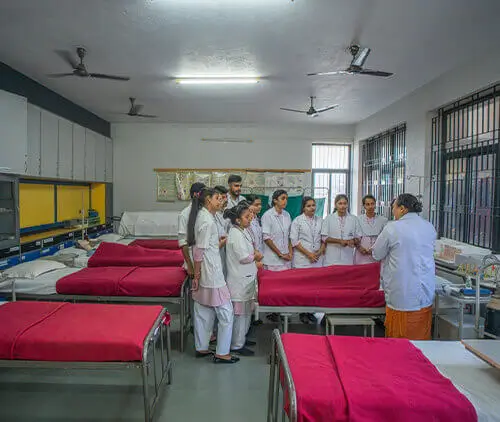
Our Institutional Strength at a Glance
In Acharya College of Nursing, credibility is established on years of stable performance, robust regulatory approvals and student results. Acharya College of Nursing is one of the top nursing colleges in Bangalore for MSc that integrates institutional heritage with progressive healthcare training to make confident, competent professionals.
- Founded in 2003 — more than 20 years of academic achievement in nursing and health science.
- KNC Recognised — approved by the Karnataka Nursing Council.
- 100% Placement Assistance — 100% of MSc Nursing graduates secure positions in multi-speciality hospitals.
- INC Approved — recognised by the Indian Nursing Council.
- RGUHS Affiliated — academic affiliation with Rajiv Gandhi University of Health Sciences.
- 2500+ Alumni Network — a strong professional community across India and abroad.
About MSc Nursing at Acharya College of Nursing
Academic Philosophy
Acharya College of Nursing believes that postgraduate education for MSc nursing in Bangalore should not be only theoretical. Our curriculum is in line with INC and RGUHS standards, with emphasis on advanced subject mastery, analytical thinking, ethical practice and leadership capability. Students are trained to apply knowledge in real healthcare practice rather than only in tests. Education at Acharya College of Nursing is progressive, outcome-driven and structured.
- Advanced subject mastery
- Analytical thinking
- Ethical practice
- Leadership capability
Research Orientation
Powerful practitioners use evidence-based practice. From the first year of the MSc nursing at Acharya College of Nursing, students are introduced to research methodology, interpretation of data and dissertation planning. This approach strengthens critical evaluation skills, academic writing, policy-level thinking and innovation in patient care. By incorporating research into the broader perspective of health sciences, Acharya College of Nursing — one of the best Bangalore MSc Nursing colleges — ensures graduates can make significant contributions to changing healthcare systems.
Leadership Development
Healthcare in modern times requires leaders. Using management and advanced-practice modules, students develop decision-making skills, communication clarity, team supervision ability and organisational understanding. Cases, seminars and supervised discussions train students to handle departments, mentor junior staff and influence care-quality standards. Leadership cannot simply be taught, but it can be developed through established interaction.
Clinical Integration Model
Our postgraduate strength is in clinical learning. Acharya College of Nursing offers organised hospital placements in government and privately owned organisations. Regular clinical immersion guarantees on-the-fly patient management, exposure to hi-tech equipment, interdisciplinary collaboration and practical skill refinement. Acharya College of Nursing ensures long-term clinical rotation to develop confidence and advanced competence, unlike institutions with minimal access to hospitals.
Global Career Readiness
There are opportunities in healthcare beyond national boundaries. Acharya College of Nursing equips graduates with national and global opportunities by integrating academic and clinical excellence with leadership qualities and education. Graduates are suited to work as Nurse Educators, Clinical Specialists, Researchers, Hospital Administrators and Public Health Experts. This equilibrium framework distinguishes Acharya College of Nursing from numerous nursing colleges more concerned with completing the curriculum than advancing careers.
Why Choose Acharya College of Nursing?
Acharya College of Nursing is known as one of the best MSc colleges for nursing in Bangalore. The college boasts high academic integrity, followed by systematic clinical practice and career-oriented training.
Regulatory Recognition
- Authorised by the Indian Nursing Council.
- Recognised by the Karnataka Nursing Council.
- Affiliated with Rajiv Gandhi University of Health Sciences.
Experienced Faculty
- Academicians with strong hospital backgrounds.
- Unremitting dissertation supervision.
- Ongoing education counselling.
Advanced Clinical Exposure
- Multi-speciality hospital rotations.
- Government and private hospital postings.
- Supervised specialty-department training.
Modern Simulation Labs
- Emergency and critical-care simulations.
- Skill refinement before hospital exposure.
- Scenario-based clinical practice.
Structured Career Support
- Resume and interview training.
- Hospital and recruiter tie-ups.
- Professional career guidance.
Researched Curriculum
- Training on structured research methodology.
- Dissertation advice and biostatistics.
- Focus on evidence-based practice.
Which MSc Nursing Specialisations Are Available?
The postgraduate education at Acharya College of Nursing is anchored on purposeful academic rigour and methodical clinical superiority. The MSc programme has five advanced-level specialisations focused on the changing needs of healthcare systems, public-health institutions and academics. All specialisations combine the best theory, guided research and rigorous hospital training in keeping with INC and RGUHS requirements.
Medical-Surgical Nursing
The specialisation makes students ready to deal with complicated adult health conditions in acute and critical-care environments, with a focus on high-order evaluation, diagnostic support and interprofessional coordination.
What you will learn:
- Critical care management
- Oncology and palliative nursing
- Enterology and obstetrics
- Emergency and trauma procedures
Clinical training: Rotations in the ICUs, surgical ward, recovery units and speciality departments of multi-speciality hospitals.
Career scope:
- Critical Care Specialist Nurse
- Supervisor of the surgical department
- Clinical educator
- Hospital operations coordinator
Community Health Nursing
This specialisation benefits population health and suits those interested in preventive care; it focuses on enhancing healthcare systems at the community level.
What you will learn:
- Epidemiology
- Public health planning
- National health programs
- Promotional and preventive measures
Clinical training: Postings include primary health centres, rural health units, vaccination drives and community outreach programmes.
Career scope:
- Public health officer
- Health program coordinator with the government
- NGO health consultant
- Community nursing educator
Paediatric Nursing
The specialisation majors in thorough healthcare services for infants, children and adolescents, in both clinical and preventive care.
What you will learn:
- Neonatal intensive care
- Growth and development evaluation
- Paediatric emergencies
- Family-centred care models
Clinical training: Exposure across NICU, PICU, paediatric wards, immunisation and child-development centres.
Career scope:
- Paediatric nurse specialist
- NICU supervisor
- Child health educator
- Paediatric research assistant
Obstetric & Gynaecological Nursing
This specialisation is concerned with maternal health, reproductive care and the health of women across various healthcare settings.
What you will learn:
- Management of high-risk pregnancy
- Labour and delivery management
- Reproductive health counselling
- Postnatal care strategies
Clinical training: Students work in labour rooms, antenatal clinics, maternity and gynaecology departments.
Career scope:
- Labour ward in-charge
- Maternal health consultant
- Health coordinator of women’s programmes
- Clinical instructor
Psychiatric Nursing
Targeting mental health care, students are oriented towards therapeutic, rehabilitative and behavioural health roles.
What you will learn:
- Methods of psychiatric examination
- Counselling frameworks
- Addiction rehabilitation
- Mental health services to the community
Clinical training: Placements in psychiatric hospitals, rehabilitation centres, de-addiction centres and mental-health outreach.
Career scope:
- Psychiatric nurse specialist (PNS)
- Rehabilitation coordinator
- Mental health program officer
- Behavioural health educator
Curriculum Framework – MSc Nursing Program
The MSc Nursing curriculum at Acharya College of Nursing is designed to transform graduate nursing professionals into advanced-level clinical experts, educators, researchers and healthcare leaders. With strict adherence to the Indian Nursing Council (INC) and RGUHS guidelines, the programme balances theoretical mastery, supervised clinical immersion, research development and leadership training. From admission, students follow a systematic academic programme that guarantees organised development in knowledge, skill and professional accountability.
Year I — Academic Foundation & Speciality Orientation
The initial year develops advanced theoretical knowledge and gradually incorporates specialisation-based clinical exposure, devoted to analytical thinking, systematised patient evaluation and research literacy.
Advanced Nursing Practice
The first-year clinical basis is advanced nursing practice. It equips students to go beyond daily nursing duties and achieve advanced-level proficiency in patient assessment, intervention planning and interdisciplinary coordination. Core areas: complete health-evaluation measures, high-level disease-management systems, specialty-based patient care, critical-care fundamentals, and the ethical and legal implications of APN. Students learn to assess complex cases using systematic assessment tools, with a focus on evidence-based intervention rather than protocol-based care. At module completion students can carry out complex clinical evaluation, take part in interdisciplinary rounds, design care plans for complex cases and communicate diagnostic results with physicians.
Nursing Education
Nursing education prepares students for academic and instructional roles within healthcare institutions, presenting curriculum development and instruction planning. Major components include classroom and clinical instructional practices, academic structuring and lesson planning, assessment plans and strategies, nursing educational psychology, and digital learning-technology applications. Students participate in micro-teaching sessions, seminar presentations, teaching demonstrations and curriculum critique exercises. This MSc nursing course in Bangalore instils confidence in those who aim to become lecturers, clinical instructors or academic coordinators.
Nursing Research & Biostatistics
Research competency differentiates postgraduate from undergraduate study. This topic trains critical thinking and equips students to plan, review and analyse healthcare studies. Research-methodology training covers development of research problems, quantitative and qualitative research design, sampling techniques, data-collection methods and ethical-approval procedures. The biostatistics component covers descriptive and inferential statistics, statistical software and tools, data-results interpretation and graphical representation of findings. This is when students start identifying possible dissertation topics.
Speciality Clinical – I
Structured hospital postings support academic learning in Year I, connected to each student’s selected specialisation. Objectives: practical application of theory in patient care, advanced-procedure observation, involvement in patient rounds and care-plan development. Faculty and hospital mentors oversee students; clinical performance is measured through logbook documentation, case presentations, practical skill evaluation and direct observation. Hospital Training Hours — 1150 Hours.
Year II — Advanced Specialisation & Leadership Development
The second year builds on basic knowledge with advanced specialisation mastery and healthcare administration.
Nursing Management
Students are equipped to lead and manage hospitals and health systems. Core administrative areas: organisational structure of hospitals, human-resource management, financial planning and budgeting basics, infection-control protocols, and quality assurance and accreditation standards. Leadership development covers decision-making frameworks, conflict-resolution strategies, team-coordination techniques and interpretation and implementation of policies. The module equips graduates for supervisory and managerial roles in healthcare institutions.
Speciality Clinical – II
The second year is characterised by increased clinical immersion. Students engage in management of complex cases, supervised independent clinical decisions, coordination with multidisciplinary teams and department-level workflow analysis. Depending on the branch selected, students may be posted in Intensive Care Units, emergency departments, psychiatric units, maternal-health centres and community-health programs. Hospital Training Hours — 1400 Hours.
Dissertation & Research Project
The dissertation is one of the most academically significant components of the MSc programme. Students undergo structured mentorship through topic identification aligned with clinical relevance, literature review and theoretical-framework building, research-proposal submission, ethical-clearance application, and data collection and statistical analysis. Thesis submission and viva include draft preparation under faculty supervision, university submission, external evaluation and viva-voce examination. The process strengthens academic writing, critical thinking and research interpretation, and prepares graduates for doctoral studies or research-oriented roles.
Clinical Training & Hospital Tie-Ups
Acharya College of Nursing gives students organised practical experience in clinical settings in collaboration with well-established multispeciality hospitals, requiring students to apply advanced nursing concepts in live, supervised healthcare settings.
Structured Clinical Immersion
- 2550 total hospital training hours
- Speciality-based ward rotations
- ICU and critical-care exposure
- Interdisciplinary team participation
- Supervised patient case management
Hospital Tie-Ups
Our students train across leading multispeciality hospitals. Explore Placement Opportunities.
MSc Nursing Admission in Bangalore
Admission to the MSc programme at Acharya College of Nursing follows a transparent, structured process aligned with INC and RGUHS regulations. If you are seeking MSc nursing admission in Bangalore, Acharya College of Nursing ensures a smooth, guided experience, with personalised assistance from eligibility verification to seat confirmation.
Step 1 – Verify Eligibility Requirements
- B.Sc. Nursing / Post-Basic B.Sc. Nursing
- Required minimum percentage
- Valid State Nursing Council registration
- Experience requirement (as applicable)
Step 2 – Complete and Submit Online Application
- Complete the application form
- Upload required academic documents
- Provide registration details
- Submit supporting certificates
Step 3 – Attend Document Verification
- Academic qualification verification
- Registration validation
- Experience review (if applicable)
- Category certificate verification (if required)
Step 4 – Attend Counselling & Confirm Seat
- Specialisation preference discussion
- Fee structure briefing
- Seat allotment confirmation
- Provisional admission letter issuance
Step 5 – Pay Fees & Complete Enrollment
- Payment of the academic fee
- Submission of original documents
- Final admission confirmation
- Enrollment under RGUHS guidelines
Documents Required
- Degree certificates and mark sheets
- Nursing Council registration certificate
- Identity proof
- Passport-size photographs
- Experience certificate (if applicable)
Social Outreach & Community Engagement
At Acharya College of Nursing, education is not confined to classrooms and laboratories. Learners are actively engaged in community-based health programmes, which create social accountability and real-world knowledge.
Career Opportunities & Placements
MSc Nursing students at Acharya College of Nursing are placed in top hospitals, educational establishments, research organisations and healthcare networks in India and overseas. The programme prepares students for leadership-oriented career progression.
Nurse Educator / Clinical Instructor
- Teach undergraduate nursing programmes
- Supervise clinical training
- Develop academic modules
Nursing Researcher
- Participate in clinical research
- Work with healthcare research institutions
- Support evidence-based policy initiatives
Hospital Administrator
- Supervise nursing departments
- Coordinate hospital operations
- Implement quality systems
Public Health Specialist
- Manage community health programmes
- Work with government healthcare initiatives
- Lead preventive health campaigns
International Nursing Roles
- Work in the UK, Canada and the Gulf countries
- Pursue global licensing pathways
- Access structured international opportunities
FAQs MSc Nursing at Acharya College of Nursing
1. Which course is best in MSc Nursing?
The best MSc Nursing specialisation depends on your career goal. Medical-Surgical Nursing suits hospital leadership roles, Community Health Nursing fits public-health careers, and Paediatric, Obstetric or Psychiatric Nursing offer specialised clinical expertise.
2. Which college has 100% placement in Bangalore?
Acharya College of Nursing offers centralised 100% placement — career counselling, tie-ups with hospital recruiters and interview-preparation training — enabling graduates to secure roles in reputed healthcare facilities.
3. How many years is an MSc in Nursing?
MSc Nursing is a 2-year, full-time programme covering academic coursework, clinical training, research methodology and a dissertation, as approved by INC and RGUHS.
4. What are the subjects in MSc Nursing?
The major subjects are Advanced Nursing Practice; Nursing Education; Nursing Research & Biostatistics; and Nursing Management, plus specialisation-based clinical courses and dissertation research.
5. What is an MSc in Nursing?
MSc Nursing is a degree meant to enhance advanced clinical capabilities, research competence, teaching skills and healthcare leadership on top of undergraduate nursing training.
6. How to apply for MSc admission?
Applicants provide scholarly documents, registration certificates and the application form. Admission follows RGUHS regulations — documents are verified and a seat is confirmed.
7. Who is eligible for MSc Nursing?
Applicants should have a B.Sc. in Nursing or a Post-Basic B.Sc. Nursing degree with the required minimum marks and State Nursing Council registration. Some categories may require clinical experience.
8. Is MSc 2 years or 3 years?
An MSc in Nursing is 2 years. The programme is divided into two academic years with clinical rotations and dissertation work integrated throughout.
9. What is the scope of MSc Nursing?
In India and abroad, graduates can work as nurse teachers, clinical specialists, hospital administrators, researchers or public-health professionals.
10. What is the fee for MSc Nursing in Bangalore?
The fee is estimated at ₹2,07,000/year and is subject to regulatory changes. There may also be extra hostel and facility fees.
11. Is NEET required for an MSc Nursing?
No, MSc Nursing does not need NEET for admission. Selection is based on the selection criteria and university requirements.
12. What is the salary after MSc Nursing in India?
MSc Nursing graduates earn between ₹4 and ₹7 lakh per year in their first role. Specialists in critical care, NICU or psychiatric nursing can earn ₹8–12 lakh per year with 2–3 years of experience.
13. Can I do MSc Nursing without experience?
Yes, Post-Basic B.Sc. Nursing graduates can apply without compulsory experience. Eligibility follows the regulatory guidelines.
14. Is MSc Nursing approved by INC?
Yes, the MSc Nursing programme at Acharya College of Nursing is accredited by the Indian Nursing Council and associated with RGUHS.
15. What is the difference between BSc Nursing and MSc Nursing?
BSc Nursing is an undergraduate programme that concentrates on basic abilities, whereas MSc Nursing is a postgraduate programme offering specialised research training and leadership development.
16. Can I work abroad after an MSc in Nursing in India?
Yes, graduates can pursue international opportunities after fulfilling country-specific licensing requirements such as IELTS and professional registration.
17. What are the best specialisations in MSc Nursing?
The specialisations recognised for good career pathways are medical-surgical, community health, paediatric, obstetric & gynaecological, and psychiatric nursing.