

MSc Nursing vs BSc Nursing: What's the Real Difference?
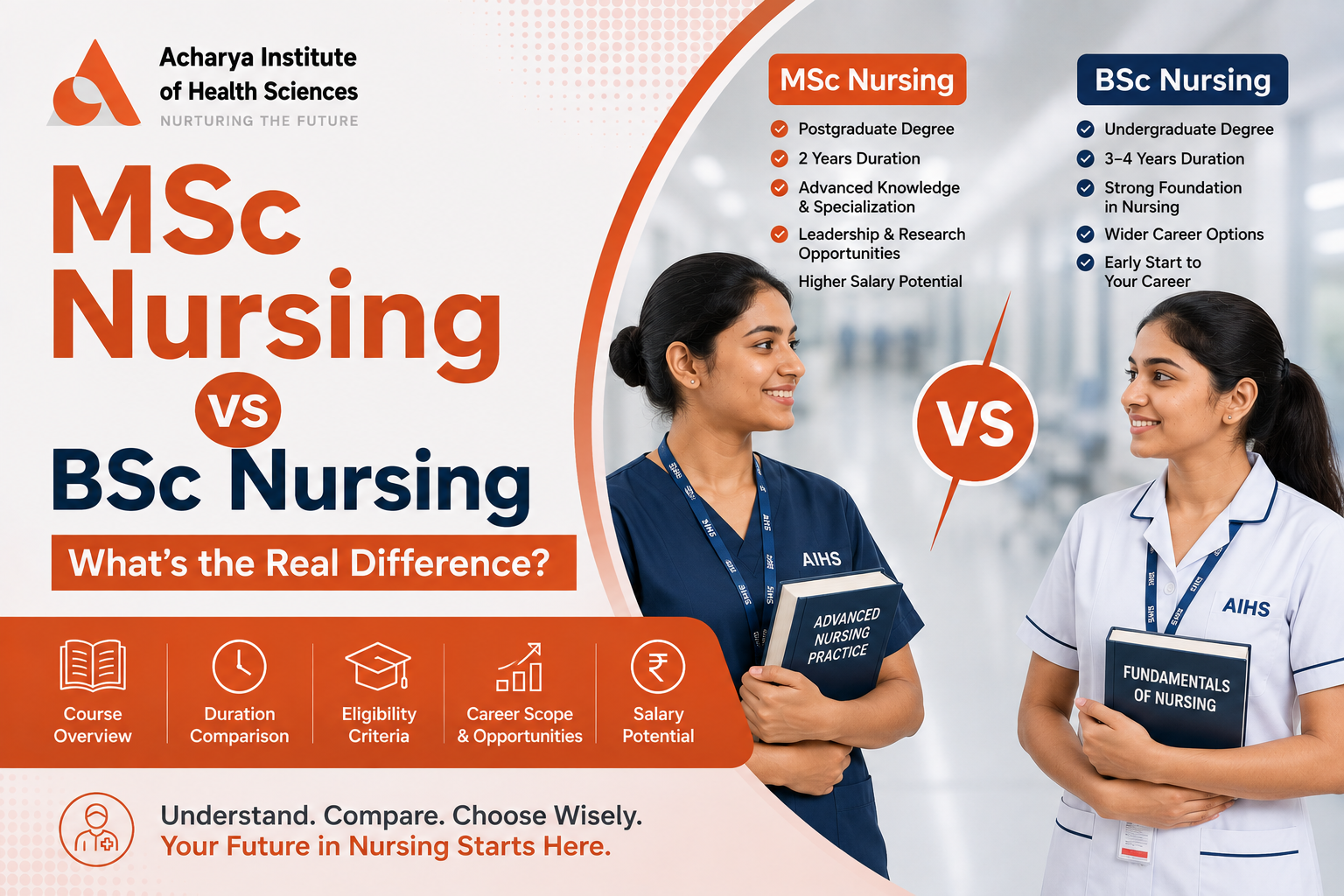
If you're a BSc Nursing student wondering whether MSc Nursing is worth two more years, you're asking the right question at the right time, usually somewhere in your final year when the "what's next" pressure starts building. This isn't really a "versus" comparison the way BBA vs B.Com is; it's a timeline question, because one degree is the foundation and the other is what you build on top of it once you know where you're headed.
This guide walks through exactly where MSc Nursing fits after your BSc, what it actually adds in curriculum, salary and career ceiling, and how to tell whether you're ready for it now or better off working a year first. No pressure to rush into a postgraduate degree just because it's available right after graduation.
What Is MSc Nursing, and How Is It Different from BSc Nursing?
MSc Nursing is a two-year postgraduate degree pursued after BSc Nursing, building advanced clinical, teaching or research expertise in one chosen specialty. That's the direct answer to what is MSc Nursing.
The difference between MSc Nursing and BSc Nursing isn't about which is better. BSc Nursing and MSc Nursing aren't competing paths, they're sequential. One is the foundation, the other is the specialisation layered on top.
| Factor | BSc Nursing | MSc Nursing |
|---|---|---|
| Level | Undergraduate degree | Postgraduate degree |
| Duration | 4 years | 2 years |
| Prerequisite | Class 12 with PCB | BSc Nursing (or equivalent) |
| Focus | Broad, foundational nursing practice | One chosen specialty, in depth |
| Typical roles | Staff nurse, clinical roles | Nurse educator, clinical specialist, researcher |
| Registration | Registered Nurse | Registered Nurse with postgraduate specialisation |
If you're still weighing your very first nursing qualification, our comparison of BSc Nursing vs GNM covers that earlier fork in the road.
Curriculum Focus Compared: Foundational Practice vs Specialised, Research-Led Study
BSc Nursing covers broad foundational nursing sciences and general clinical rotations across four years, giving you exposure to every major department before you graduate. MSc Nursing narrows that focus sharply, into one specialty such as medical-surgical, paediatric, psychiatric, community health, or obstetric and gynaecological nursing.
Expect advanced practicum hours in your chosen specialty, a research or thesis component, and typically a nursing-education paper if you're leaning toward a teaching career. The shift is real. BSc Nursing asks you to be competent across every ward. MSc Nursing asks you to go deep in one, and to back that depth with evidence you've generated yourself, not just knowledge you've absorbed.
That research component trips up a lot of first-time postgraduate students, mostly because BSc Nursing rarely demands independent research at the same level. Budget extra time for it. A thesis or dissertation isn't a formality here, it's usually a genuine requirement for the degree. We won't repeat the BSc-level syllabus here. Our detailed BSc Nursing subjects and syllabus guide covers that ground already.
Eligibility: Can You Do MSc Nursing Right After BSc Nursing?
Can I do MSc Nursing after BSc Nursing right away? Yes, BSc Nursing is the standard entry requirement for MSc Nursing, subject to university-specific minimum marks and, at many institutions, a minimum period of registered clinical experience.
At AIHS, for instance, the published eligibility for its MSc Nursing programme asks for a BSc Nursing pass with 55% aggregate marks from a recognised university, plus a minimum of one year's experience in a hospital, nursing educational institution or community health centre. That experience requirement is waived for candidates holding a Post Basic BSc Nursing degree. Always confirm the current year's cut-offs and entrance exam requirements directly with the university, since these can shift between intakes. [CONFIRM]
BSc Nursing or MSc Nursing - Which Should You Plan For First?
There's no real "which first" decision here, BSc Nursing has to come first regardless. The actual question is when to add MSc Nursing on top.
Two realistic paths exist. You can go straight through, moving from BSc Nursing into MSc Nursing with little or no gap. Or you can work for a year or two first, build clinical experience, get clear on which specialty genuinely interests you, and return to MSc Nursing once that's settled. Neither path is wrong. A lot of nurses find that a year on the floor sharpens their specialty choice more than any brochure could.
Who Should Pursue MSc Nursing? A Self-Check Before You Apply
You're likely ready for MSc Nursing if:
- You've got some clinical experience and a clear specialty interest already forming
- You're aiming at nursing education, faculty roles or hospital administration
- You want research experience or an academic publication under your belt
- You're thinking about international opportunities that reward a postgraduate qualification
BSc Nursing may be enough for now if:
- You want to start practising immediately and build experience first
- You're still undecided on which specialty genuinely interests you
- You'd rather choose your MSc specialisation after a year or two on the floor, not before
Career Paths After BSc Nursing vs MSc Nursing: Where Each Degree Takes You
BSc Nursing opens staff nurse roles and general clinical positions across specialties, which is where almost every nursing career begins regardless of future plans.
MSc Nursing opens a different tier: nurse educator or faculty roles in nursing colleges, nurse manager or supervisor positions, clinical nurse specialist roles in your chosen field, and research positions. It's also frequently the stated eligibility requirement for higher government pay scales and academic teaching posts, roles a BSc Nursing qualification alone typically doesn't unlock.
There's a ceiling effect worth naming directly. A BSc Nursing graduate can absolutely rise into senior clinical roles through years of experience alone. But the jump into a formal teaching post, a research posting, or a hospital administration role usually needs the postgraduate qualification on paper, not just the years on the floor. That's the practical reason so many experienced staff nurses circle back to MSc Nursing mid-career instead of skipping it.
MSc Nursing Salary and Growth: What the Postgraduate Degree Actually Adds
Numbers make this concrete. Per 2026 salary-tracking data, BSc Nursing freshers typically start between ₹18,000 and ₹30,000 a month in private hospitals. MSc Nursing graduates typically start noticeably higher, in the ₹35,000 to ₹60,000 a month range, and nurse educator or faculty roles that require a postgraduate qualification often pay ₹60,000 to ₹1,00,000 a month with a few years of experience.
Here's the honest pattern. A BSc Nursing salary trajectory tends to plateau without further qualification or experience-driven promotion. MSc Nursing typically unlocks supervisory, teaching and specialist pay bands instead, particularly in teaching hospitals and nursing colleges, where a postgraduate qualification is frequently a stated requirement for faculty posts, not just a preference.
Choosing Where to Study MSc Nursing in Bangalore: What to Check in a College
Once you've decided to pursue MSc Nursing, choosing among **MSc Nursing colleges in Bangalore** matters as much as the decision itself.
Check Rajiv Gandhi University of Health Sciences affiliation and Indian Nursing Council recognition for the specific specialisation you want, since not every college offers every specialty. Look at the faculty's PG and PhD ratio, whether an attached teaching hospital supports advanced clinical postings in your specialty, and whether the college offers real research or publication support.
If you're evaluating where to specialise, it's worth looking at how the MSc Nursing programme at AIHS structures its specialty tracks and clinical practicum hours, rather than judging a college on prospectus claims alone.
Frequently Asked Questions
1. What is MSc Nursing?
MSc Nursing is a two-year postgraduate degree pursued after BSc Nursing. It builds advanced clinical, teaching or research expertise in one chosen specialty, such as medical-surgical, paediatric or community health nursing.
2. Can I do MSc Nursing right after BSc Nursing?
Yes, in most cases. Universities typically require a BSc Nursing pass with a minimum aggregate, often around 55%, and sometimes a minimum period of clinical experience, though this requirement is frequently waived for Post Basic BSc Nursing graduates.
3. What is the difference between BSc Nursing and MSc Nursing?
BSc Nursing is a four-year undergraduate degree covering broad, foundational nursing practice. MSc Nursing is a two-year postgraduate degree that narrows into one specialty, with advanced practicum and a research component.
4. Is MSc Nursing necessary to become a nurse?
No. BSc Nursing or GNM already qualifies you to register and practise as a nurse. MSc Nursing is optional, pursued for specialisation, teaching, research or administrative roles rather than for basic registration.
5. What specialisations are available in MSc Nursing?
Common specialisations include medical-surgical nursing, paediatric nursing, psychiatric nursing, community health nursing, and obstetric and gynaecological nursing. Availability varies by university and college, so confirm which specialties a specific institute offers.
6. Does MSc Nursing increase salary compared to BSc Nursing?
Yes, typically. BSc Nursing salaries tend to plateau without further qualification, while MSc Nursing usually unlocks supervisory, teaching and specialist pay bands, particularly in teaching hospitals and nursing colleges.