

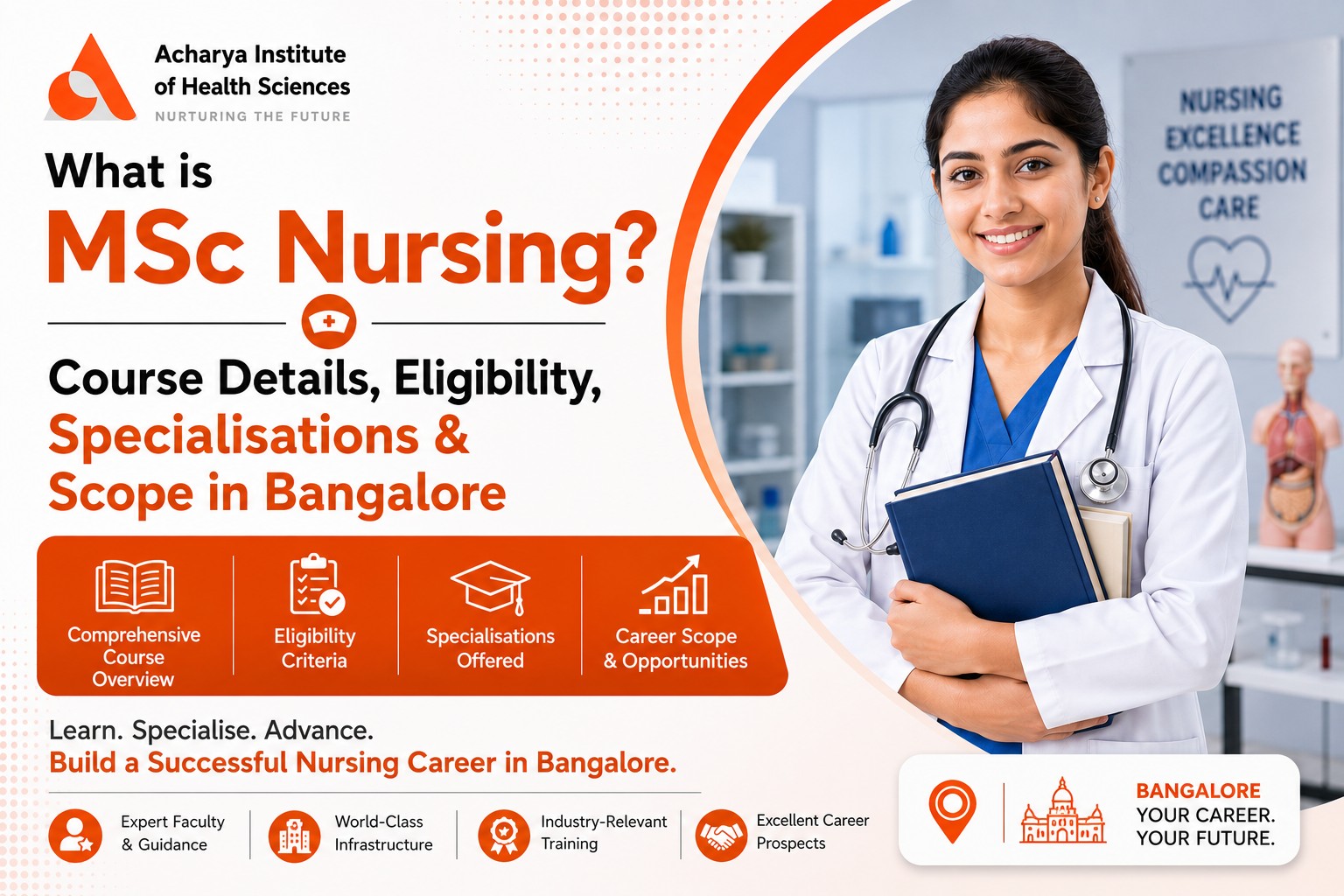
What is MSc Nursing? Course Details, Eligibility, Specialisations & Scope in Bangalore
Most BSc Nursing graduates hit a point around two or three years into their first job where a question surfaces that nobody in college prepared them for. You are clinically competent. You know the ward. You know the patients. But the roles that pay more and carry more authority seem to go to people with a postgraduate qualification you do not yet have.
MSc Nursing is that qualification. Here is what it actually involves.
What is MSc Nursing?
MSc Nursing is a two-year postgraduate degree for registered nurses. It is not simply more of BSc Nursing. The academic level, clinical expectations, and professional outcomes are genuinely different.
Where BSc Nursing trains you to be a competent bedside nurse, MSc Nursing trains you to lead clinical departments, teach undergraduate nursing students, contribute to healthcare research, and practise as a specialist in a defined area. The programme covers advanced nursing practice, nursing education, research methodology, biostatistics, nursing management, and a dissertation that requires original clinical research.
In Karnataka, MSc Nursing is affiliated to Rajiv Gandhi University of Health Sciences (RGUHS) and approved by the Indian Nursing Council (INC). The qualification opens licensing pathways in the UK, Canada, Australia, and the Gulf nations.
Can I Do MSc Nursing After BSc Nursing?
Yes. This is precisely who the programme is designed for.
BSc Nursing is the standard entry qualification for MSc Nursing across India. Post-Basic BSc Nursing graduates are also eligible, in some cases without a mandatory experience requirement. Regular four-year BSc Nursing graduates may need to show a period of clinical experience before admission, depending on RGUHS guidelines for that particular intake cycle.
You can apply provided you have a BSc Nursing degree, and you are duly registered with the State Nursing Council. Confirm the exact percentage requirement and experience requirements with the college since they may change with each year.
MSc Nursing Eligibility Criteria
The general eligibility criteria of MSc Nursing in Bangalore:
- BSc Nursing or Post-Basic BSc Nursing from a recognised university.
- Minimum aggregate percentage as prescribed by the institution and RGUHS.
- Registered with a valid State Nursing Council.
- Experience certificate as required by the admission regulations.
MSc Nursing does not have NEET. The admission is on merit, which is controlled by your academic record and registration by the nursing council.
MSc Nursing Duration and Admission Process
MSc Nursing runs across two years and four semesters. Clinical immersion and research responsibilities increase progressively. The second year is considerably more demanding than the first in both respects.
Typical admission process at Bangalore colleges:
- Gather documents including degree certificates, mark sheets, nursing council registration, and identity proof.
- Submit the online application with supporting certificates.
- Attend document verification at the institution.
- Attend counselling for specialisation preference and fee structure discussion.
- Confirm the seat by paying the initial fee and submitting original documents.
Admission windows typically open ahead of a July or August start. Seats in preferred specialisations fill quickly at well-regarded colleges. Applying early is the practical difference between getting your first-choice specialisation and settling for a second.
MSc Nursing Specialisations Explained
Choosing a specialisation is the decision that shapes the rest of your nursing career. Each track leads somewhere specific.
- Medical-Surgical Nursing: Prepares you for complex adult health conditions in acute and critical care environments. Rotations cover ICUs, surgical wards, and speciality departments. Graduates move into critical care specialist, surgical department supervisor, and clinical educator roles. This is typically the highest-paying hospital-based path within MSc Nursing.
- Community Health Nursing: Focuses on population health, preventive care, and public health systems. Postings include primary health centres and community outreach programmes. Graduates work as public health officers and government health programme coordinators.
- Paediatric Nursing: Covers healthcare for infants, children, and adolescents, including neonatal intensive care and paediatric emergencies. Clinical exposure spans NICU, PICU, and paediatric wards. Graduates take up paediatric nurse specialist and NICU supervisor roles.
- Obstetric and Gynaecological Nursing: Centres on maternal health, reproductive care, and women's health. Students work in labour rooms, antenatal clinics, and maternity departments. Graduates move into labour ward in-charge and maternal health consultant positions.
- Psychiatric Nursing: Focuses on mental health care, therapeutic practice, and rehabilitation. Placements include psychiatric hospitals, rehabilitation centres, and de-addiction units. Graduates work as psychiatric nurse specialists and mental health programme officers.
MSc Nursing Colleges in Bangalore
Bangalore has several RGUHS-affiliated MSc Nursing colleges. The city's concentration of multi-speciality hospitals makes it particularly well-suited for a postgraduate nursing programme.
When shortlisting, look beyond the brochure. INC approval, RGUHS affiliation, KNC recognition, and documented hospital tie-ups for clinical rotations are what actually determine the value of the two years you invest. Ask specifically about the total supervised clinical training hours. More hours in better hospitals means more competent graduates, and employers in Bangalore can tell the difference.
MSc Nursing Salary in India
| Role / Level | Monthly Salary Range |
|---|---|
| Fresher MSc Nurse (private hospital) | Rs. 25,000 to Rs. 40,000 |
| Clinical Specialist (3 to 5 years) | Rs. 40,000 to Rs. 65,000 |
| Nurse Educator / Lecturer | Rs. 30,000 to Rs. 55,000 |
| Head Nurse / Department In-charge | Rs. 50,000 to Rs. 80,000 |
| Nursing Superintendent | Rs. 70,000 to Rs. 1,20,000 |
MSc Nursing salary in India per month is notably higher than BSc Nursing equivalents at every experience level. This is not a marginal difference. The postgraduate qualification moves you into a different professional tier. Bangalore specifically offers the stronger end of these ranges because corporate hospitals and speciality centres in the city actively recruit postgraduate-qualified nurses for roles that BSc graduates cannot fill.
MSc Nursing Jobs and Career Opportunities
The career landscape after MSc Nursing is broader than most students expect when they begin the programme.
Nurse Educator and Clinical Instructor: Roles at nursing colleges involve teaching undergraduate students and supervising clinical training. Demand is consistent and growing as new nursing colleges open across India, and INC guidelines increasingly require MSc-qualified faculty.
Clinical Specialist: Roles in corporate hospitals carry real departmental responsibility. ICU specialists, OT charge nurses, and NICU senior nurses with MSc qualifications command salaries that BSc-level nurses in the same departments simply cannot negotiate.
Nursing Research: Positions are available at medical colleges and public health organisations. Graduates with strong dissertation work are well-placed for these roles.
Hospital Administration: Opens through the nursing management component of the degree. Nursing superintendent and quality assurance officer roles are ones that MSc graduates with a few years of experience move into regularly.
International Nursing: Is a significant draw for many graduates. MSc Nursing holders with good clinical records and English proficiency are eligible for registration in the UK, Canada, Australia, and Gulf countries, with salaries that run three to five times what Indian hospitals pay for comparable roles.
MSc Nursing vs BSc Nursing: Key Differences
| Parameter | BSc Nursing | MSc Nursing |
|---|---|---|
| Level | Undergraduate | Postgraduate |
| Duration | 4 years | 2 years |
| Focus | Core clinical nursing skills | Specialisation, research, leadership |
| Roles | Staff nurse, junior clinical roles | Clinical specialist, educator, researcher, administrator |
| Teaching Eligibility | Not eligible to teach at nursing colleges | Eligible to teach undergraduate nursing programmes |
| Entry Salary | Rs. 12,000 to Rs. 20,000/month | Rs. 25,000 to Rs. 40,000/month |
| International Scope | Limited without additional qualification | Stronger eligibility for international licensing pathways |
BSc Nursing gives you the licence to practise. MSc Nursing gives you the authority to lead, teach, and specialise. For nurses who want to move beyond ward-level roles within five to seven years of qualifying, MSc Nursing is not an optional upgrade. It is the necessary next step.
Future Scope of MSc Nursing in India and Abroad
India's healthcare sector is expanding at a pace that requires considerably more postgraduate-qualified nursing professionals than are currently graduating.
INC guidelines have raised the bar for nursing educators. Nursing colleges increasingly require MSc-qualified faculty, and that demand is only growing. The expansion of corporate hospital chains across Tier 1 and Tier 2 cities is creating sustained demand for senior clinical nurses. Government healthcare initiatives in public health and community nursing are generating positions that specifically require postgraduate knowledge and research capability.
Internationally, demand for Indian MSc Nursing graduates is growing in markets that face persistent workforce shortages. The UK, Canada, Australia, and several Gulf countries have structured licensing pathways for Indian nursing graduates. Having an MSc makes candidates considerably more competitive on those pathways. The number of Bangalore-trained postgraduate nurses working abroad right now reflects that clearly.
Frequently Asked Questions
1. Can I do MSc Nursing directly after BSc Nursing without work experience?
Post-Basic BSc Nursing graduates can often apply without mandatory experience. Regular BSc Nursing graduates may need to meet an experience requirement depending on RGUHS regulations for that intake year. Confirm this directly with the college.
2. What is the MSc Nursing salary in India per month for freshers?
Freshers with an MSc Nursing degree typically earn Rs. 25,000 to Rs. 40,000 per month in private hospitals, substantially higher than BSc Nursing entry-level salaries. Bangalore offers the higher end of this range.
3. Is NEET required for MSc Nursing admission?
No. Admission is based on your BSc Nursing academic record, nursing council registration, and the institution's merit-based selection process. NEET does not apply.
4. Which MSc Nursing specialisation has the best career scope?
Medical-Surgical Nursing and Paediatric Nursing offer the broadest hospital-based options. Community Health Nursing is strong for public sector and NGO roles. The right choice depends on where you actually want to work, not just which one pays the most in the short term.
5. What MSc Nursing jobs are available in Bangalore?
Clinical specialist roles in corporate hospitals, nurse educator positions at nursing colleges, research associate roles at medical institutions, and hospital administration positions are all available. Bangalore is one of the strongest markets for MSc Nursing graduates in southern India.
Conclusion
MSc Nursing is the qualification that separates a career in nursing from a career spent in nursing. The difference is in what you are authorised to do, what you are trusted to lead, and what you can earn across a professional lifetime.
For BSc Nursing graduates in Bangalore weighing this decision, the choice of institution matters as much as the decision itself. Clinical hours, specialisation mentorship, dissertation supervision, and hospital partnerships all shape what the two years are genuinely worth.